
COMANCO Insights on Domestic Lithium Development and Environmental Construction
Recent news surrounding lithium resources in the Appalachian region has created significant discussion across the mining and energy industries. The U.S. Geological Survey (USGS) recently released findings showing that the Appalachian region may contain an estimated 2.3 million metric tons of undiscovered, economically recoverable lithium oxide.
As demand for electric vehicles and battery storage systems continues growing, domestic lithium development has become an increasing priority throughout the United States. Manufacturers, operators, and regulators are all looking for ways to strengthen domestic mineral supply chains while reducing dependence on imported materials.
However, mineral discovery is only one piece of the equation.
Large-scale mining operations depend on reliable environmental infrastructure throughout every stage of development and operation. Water management systems and containment infrastructure play an important role in helping mining operations maintain compliance, efficiency, and environmental protection.
As a result, experienced environmental contractors remain essential to mining development across both established and emerging regions today.
Mining Development Requires More Than Resource Discovery
Discovering a lithium resource is only one step in the development process. Before production can begin, projects of this type often require years of planning, permitting, and environmental review. Operators also need reliable infrastructure to maintain environmental compliance and operational stability throughout the life of the facility.
Modern mining operations face strict environmental requirements every day. Teams must safely manage water movement, maintain critical environmental controls, and protect surrounding areas from potential environmental impacts. As a result, environmental construction becomes a major part of both project development and long-term operations.
Large-scale mining facilities rely heavily on properly constructed containment and water management systems to operate safely and efficiently. Successful projects depend on experienced crews who understand how changing site conditions, construction sequencing, and quality control all affect containment performance over time. In addition, contractors must maintain consistent inspection and testing procedures throughout construction to help ensure containment integrity.
These systems help protect surrounding land and water resources while supporting safe mining operations. At the same time, they help operators reduce environmental risk and maintain regulatory compliance.
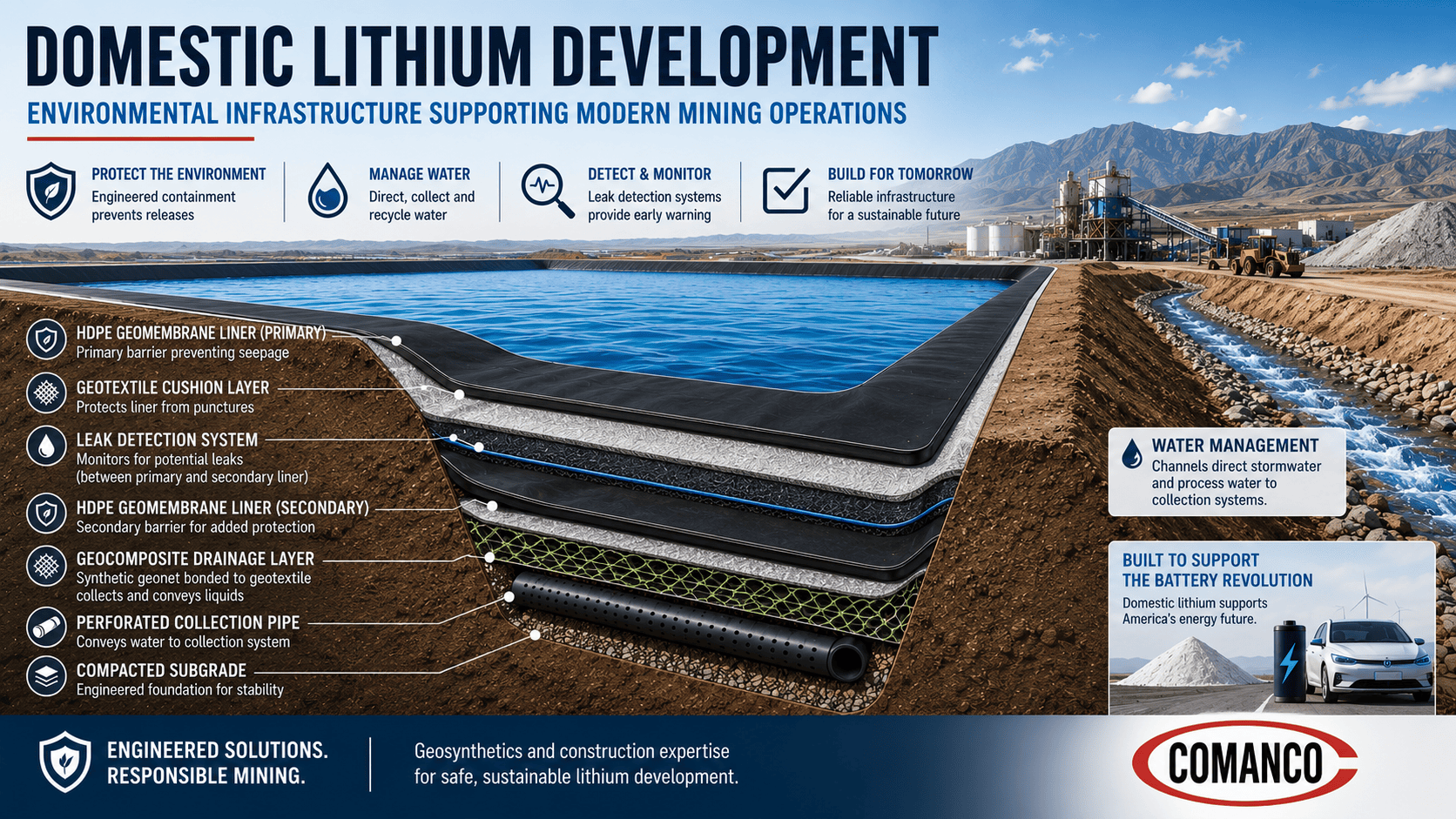
Cross-section infographic of a double-lined HDPE lithium process pond and its containment layers
Experience From Established Mining Regions Remains Valuable
While recent headlines have focused on Appalachia, established mining regions in the western United States continue providing valuable insight into lithium and mineral development.
Nevada remains one of the most active mining regions in North America. Mining operations throughout the state operate in demanding conditions that require durable containment systems, experienced field crews, and strict quality control procedures.
COMANCO has supported mining operations across Nevada and other western mining regions for decades. Our crews understand the demands of active mining environments and the importance of building containment systems that support reliable operations and ongoing environmental protection.
Mining infrastructure projects rarely come with predictable conditions. Field crews must constantly respond to changing site demands while maintaining production schedules and meeting regulatory expectations.
Because of this, successful mining projects require far more than simply installing materials. Experienced contractors must understand how construction sequencing, quality control, and field coordination all contribute to overall project performance.
Managing Water and Containment in Modern Mining Operations
Water management remains a major part of mining construction and operations. Mining facilities rely on carefully designed containment and water-management infrastructure to support safe, efficient daily operations.
Containment failures can create serious operational disruptions and environmental concerns. Therefore, operators often prioritize quality installation and dependable system operation from the earliest stages of development.
Experienced contractors understand that successful containment systems depend on consistent attention to detail throughout construction. Small installation issues can quickly develop into larger operational concerns, which is why quality control and proper field execution remain critical from start to finish.
As a result, mining operators often rely on experienced environmental contractors to help reduce risk and maintain system integrity.
Key components of a lithium containment pond. The infographic above breaks down the layers of a typical lithium process pond. The table summarizes each component and its function.
| Component | Function |
|---|---|
| Primary HDPE geomembrane | Prevents seepage from the process pond |
| Geotextile cushion layer | Protects the geomembrane from punctures |
| Leak detection layer | Monitors containment integrity between the liner systems |
| Secondary HDPE geomembrane | Redundant containment barrier beneath the primary liner |
| Geonet drainage composite | Collects and conveys liquids within the system |
| Perforated collection piping | Directs liquids to monitoring or recovery systems |
| Water management channels | Control stormwater and process-water flows around the site |
Domestic Lithium Development Will Continue to Expand
Recent news on the Appalachian lithium resource reflects broader momentum in domestic lithium development and critical mineral investment in the United States.
Projects associated with lithium extraction and mineral processing will require experienced teams capable of supporting containment infrastructure, water management systems, and geosynthetic installation under demanding field conditions.
Lithium resource development may begin with geology, but successful mining operations ultimately depend on the infrastructure built around them. As domestic lithium development continues to expand, the industry will need experienced teams that understand the construction demands and environmental responsibilities tied to modern mining infrastructure.
Frequently Asked Questions
How much lithium is in the Appalachian region?
According to the U.S. Geological Survey, the Appalachian region may hold an estimated 2.3 million metric tons of undiscovered, economically recoverable lithium oxide.
Why is environmental infrastructure important in lithium mining?
Lithium operations must manage water movement, prevent seepage, and protect surrounding land and groundwater. Containment and water management systems allow projects to maintain compliance and operate safely throughout the life of the facility.
What containment systems do lithium mining operations use?
Process ponds typically use a double-lined system: a primary HDPE geomembrane backed by a secondary HDPE geomembrane, with a leak detection layer between them, a geonet drainage composite, perforated collection piping, and water management channels.
Where is lithium currently mined in the United States?
Nevada is one of the most active mining regions in North America, while emerging regions such as Appalachia are now drawing interest following recent USGS findings.
SAFETY ★ QUALITY ★ SERVICE
COMANCO is an environmental, commercial, and civil construction company specializing in constructing containment facilities.
The growing focus on domestic lithium development highlights the importance of reliable environmental infrastructure in modern mining operations. From containment systems to water management solutions, COMANCO brings decades of experience supporting mining projects in active operating environments.
Contact COMANCO to learn more about our environmental construction services.
📍 4301 Sterling Commerce Dr, Plant City, FL 33566
📞 (813) 988-8829
🌐 www.comanco.com
LinkedIn | Facebook | Instagram | X | YouTube