

by COMANCO | Last updated: August 21, 2026
Heap leach pad construction builds an engineered containment system that supports mineral recovery while protecting soil and groundwater. A modern pad combines a prepared subgrade, a geomembrane liner, drainage layers, collection piping, and leak detection into one system. Crews build it in a defined sequence, and quality personnel verify each phase before the next begins. That sequence matters, because most deficiencies stay hidden once ore covers the pad. Below, we walk through each component, the construction sequence, the quality checks that verify the work, and why coordination determines long-term performance.
What is a heap leach pad?
A heap leach pad is an engineered containment facility that recovers metals such as gold, silver, and copper from crushed ore. Rather than processing ore entirely in a mill, operators stack crushed ore on the pad and apply a leaching solution across the surface. As the solution moves through the ore, it dissolves the target metals and drains into the system beneath the heap.
That recovered liquid carries a name of its own. Operators call it pregnant solution. It flows through drainage aggregate and collection piping to a processing plant, which extracts the dissolved metals. Many operations then treat the solution and recirculate it through the heap.
Because the solution carries process chemicals and dissolved metals, the pad serves two purposes at once. It supports efficient recovery, and it protects the surrounding environment. COMANCO builds these systems across mining and environmental markets.
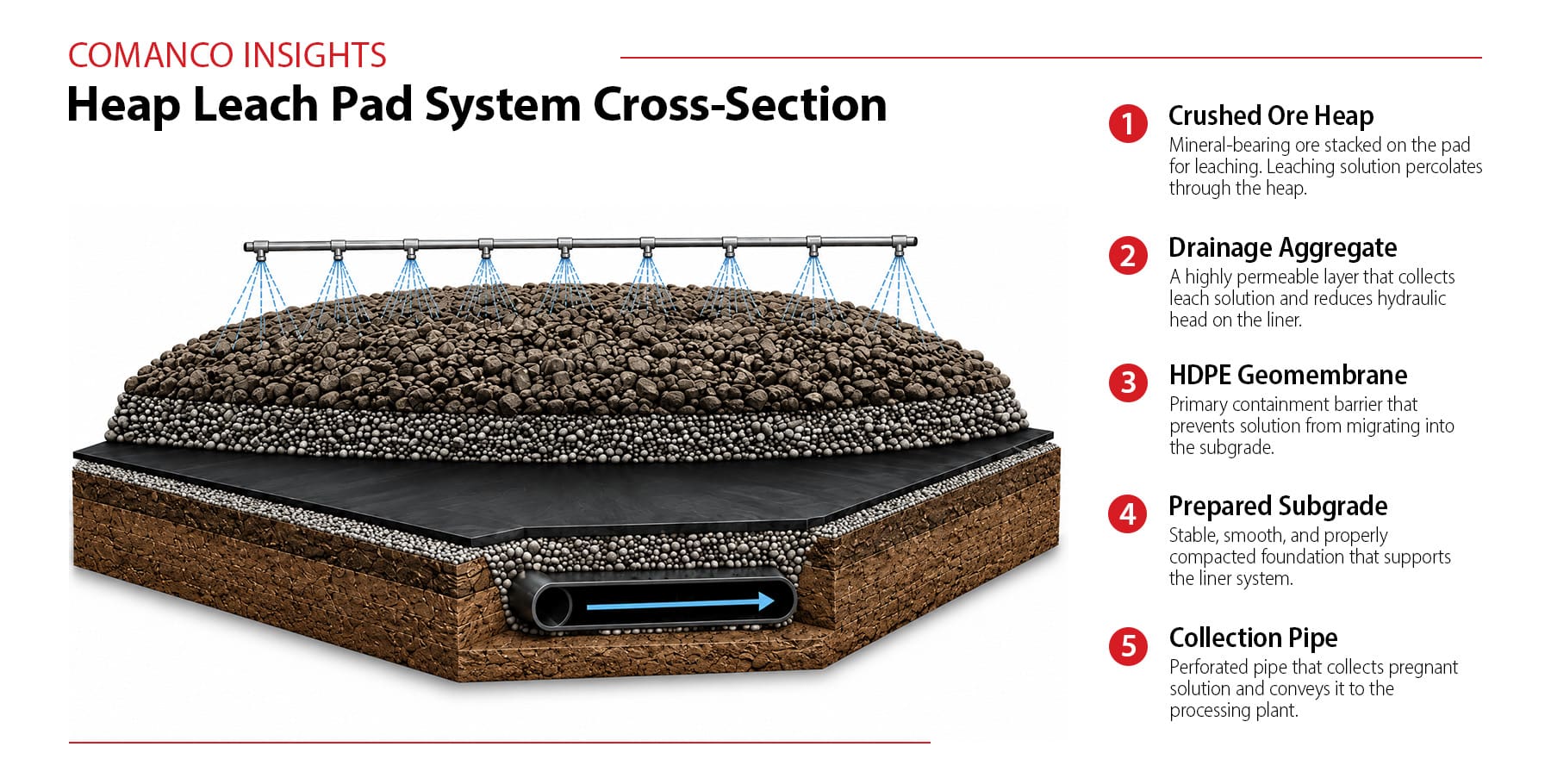
Figure 1. Heap leach pad system cross-section, showing the crushed ore heap, drainage aggregate, HDPE geomembrane, prepared subgrade, and collection pipe.
What are the components of a heap leach pad?
Heap leach pad construction combines five engineered components into a single system. The table below summarizes what each one does.
| Component | Function |
|---|---|
| Prepared subgrade | Provides a smooth, stable foundation that supports and protects the liner |
| Geomembrane liner | Forms the primary containment barrier against solution migrating into soils |
| Drainage layer | Collects solution quickly and minimizes hydraulic head on the liner |
| Collection piping | Conveys pregnant solution to the processing plant |
| Leak detection system | Captures and flags any solution passing the primary liner, where specified |
Although the geomembrane liner draws most of the attention, it is one part of a larger system. Long-term performance depends on how well every component works with the others.
Why do geomembrane liners matter in heap leach pad construction?
The geomembrane liner serves as the primary containment barrier. Most modern pads use high-density polyethylene, or HDPE, because it resists chemicals and punctures, tolerates ultraviolet exposure, and performs over long service lives in demanding mining environments.
However, material selection alone does not determine performance. Four other factors matter just as much: the quality of the subgrade underneath, the integrity of the welded seams, the testing procedures crews follow, and the protection the liner receives during later construction.
For that reason, owners and engineers put weight on installation quality assurance. Correcting a problem during construction is far easier than reaching it after drainage material and ore sit on top.
How does subgrade preparation affect heap leach pad construction?
Crews must prepare the foundation before a liner goes down. The quality of that earthwork drives the performance of the whole containment system, which makes subgrade preparation one of the most consequential phases of the project.
Subgrade acceptance marks one of the last milestones before liner installation begins. It confirms that the foundation meets specification and can receive the primary containment system. A properly prepared subgrade gives crews a smooth, stable surface and protects the geomembrane for the life of the facility.
During design, engineering teams evaluate the soils supporting the facility. That evaluation may cover geotechnical investigations, groundwater conditions, settlement potential, and slope stability. Once design finishes, performance then depends on construction, installation quality, and verification.
After earthwork finishes, inspectors walk the finished subgrade against specification. The surface should read smooth and properly compacted, with no rocks, debris, or abrupt grade changes that could damage the liner.
Geomembranes are durable, but they cannot compensate for a poor foundation. A single rock beneath the liner becomes a concentrated stress point once millions of tons of ore sit above it. Consequently, what looks trivial during construction can turn into an expensive repair later.
What is the heap leach pad construction sequence?
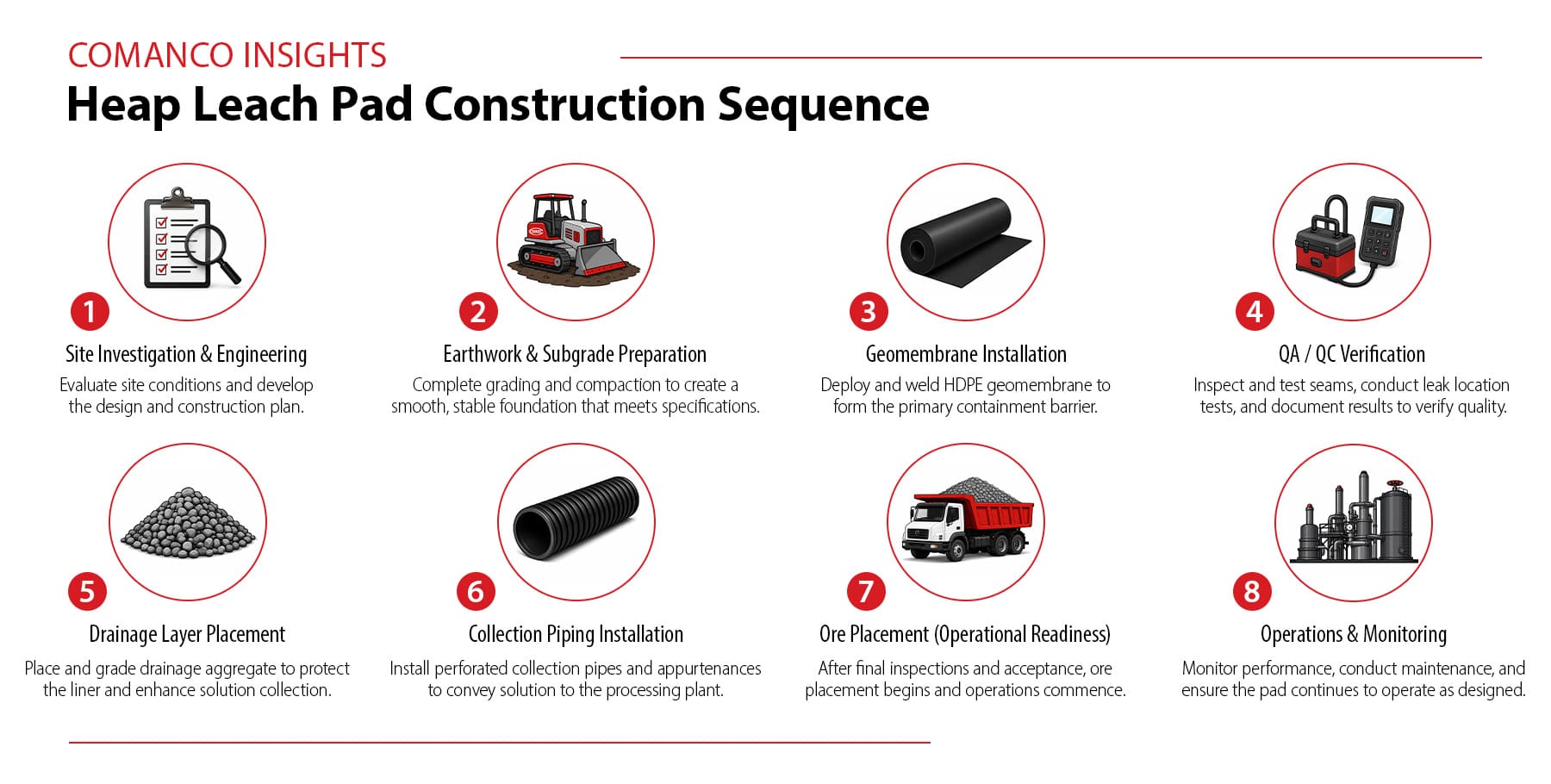
Every mining project carries its own design requirements. Even so, most heap leach pad construction projects follow a similar order. The table below lays out a typical sequence and what each phase accomplishes.
| # | Phase | What happens in this phase |
|---|---|---|
| 1 | Site investigation and engineering | Evaluate site conditions, then develop the design and construction plan |
| 2 | Earthwork and subgrade preparation | Grade and compact to a smooth, stable foundation, then inspect and accept the subgrade against specification |
| 3 | Geomembrane installation | Install the leak detection layer where specified, then deploy and weld HDPE panels to form the primary barrier |
| 4 | QA / QC verification | Inspect and test seams, run leak location surveys, and document results |
| 5 | Drainage layer placement | Place and grade drainage aggregate to protect the liner and improve solution collection |
| 6 | Collection piping installation | Install perforated pipe and appurtenances, and build out the pregnant solution collection system |
| 7 | Ore placement | Complete final inspection and documentation, then begin stacking ore |
| 8 | Operations and monitoring | Monitor performance, perform maintenance, and confirm the pad operates as designed |
Each step builds on the one before it. Therefore, quality at every stage supports how the containment system performs once the facility operates.
How do crews install the liner in heap leach pad construction?
Once the subgrade passes acceptance, installation of the primary containment system begins.
Successful installation starts well before the first panel unrolls. Crews deploy each panel on a planned sequence that accounts for weather, site logistics, and other trades working nearby. Good sequencing cuts unnecessary handling, limits how much liner sits exposed, and protects finished work until drainage material covers it.
No two installation days match. Wind, temperature, moisture, and shifting site conditions all change how a crew deploys, welds, and inspects a panel. Experienced crews read those conditions continuously and adjust rather than push through them.
Crews join adjacent panels with thermal fusion welding, which creates a continuous barrier. Technicians then inspect and test every production seam against specification before other work proceeds.
How does quality assurance verify the installation?
Quality assurance does not start at seam testing. It runs through every stage of installation. The table below lists the activities a typical program includes.
| Activity | What it verifies | Reference |
|---|---|---|
| Continuous visual inspection | Surface damage, wrinkles, foreign material | Project specification |
| Air pressure testing, dual-track seams | Continuity along the full seam length | ASTM D5820 |
| Vacuum box testing | Continuity of extrusion welds, details, repairs | ASTM D5641 |
| Destructive seam sampling | Peel and shear strength of fusion seams | ASTM D6392 |
| Documentation of repairs and retesting | Every defect found was corrected and reverified | Project specification |
| Material traceability | Which roll and resin batch sits where on the pad | Project specification |
| Daily quality control records | Conditions, crews, and work completed each day | Project specification |
The objective goes beyond finishing the installation. Crews and technicians verify that the system will perform as designed before drainage material and millions of tons of ore cover it. For a closer look at how digital records change that process, see our work on real-time weld documentation.
How do heap leach pad drainage systems work?
A pad has to move solution as well as contain it. Once the leaching solution passes through the ore, it needs a clear path to the collection system.
Crews install drainage aggregate or geocomposite drainage products above the liner. These materials create a highly permeable flow path that directs solution toward the collection piping and limits how much liquid lingers above the liner.
That serves a second purpose. Solution standing above the liner creates hydraulic head, which is simply pressure against the containment system. The greater the head, the greater the chance solution finds any defect that exists. Efficient drainage lowers that pressure while improving collection.
Well-built drainage also spreads flow more evenly across the pad. Instead of pooling in isolated areas, solution moves steadily toward the collection system.
How do collection piping and leak detection work?
After the drainage layer, pregnant solution enters a network of perforated collection pipes that carry it to the processing facility.
The pipe itself is only part of the story. Alignment, slope, connections, and installation quality all shape how efficiently solution moves.
Many modern pads add secondary containment and leak detection. Depending on the design, these systems use secondary geomembranes, geonets, geocomposite drainage layers, monitoring sumps, and dedicated piping.
Leak detection systems surface potential issues early. Consequently, operators can investigate an unexpected reading and respond before it affects operations or the environment.
How is heap leach pad construction quality verified?
Project teams need confidence that crews installed every component as intended before the pad enters service. Verification produces that confidence.
Throughout construction, engineers and quality personnel document inspections, tests, and completed work against the project specifications. Those records show owners and engineers that the facility matches the design.
The records also outlive construction. They establish a baseline for maintenance, expansion, operational planning, and regulatory documentation. Years later, they let a project team reconstruct how crews built and verified the system.
Why does coordination matter in heap leach pad construction?
Successful heap leach pad construction depends on more than individual workmanship. It depends on coordination.
Earthwork, liner installation, drainage placement, piping, surveying, and quality assurance all have to line up. Each phase builds on the last, and every trade protects the work of the trade before it.
Schedules rarely hold. Weather turns, site access changes, and priorities shift. Experienced teams adapt without lowering the standard the containment system requires.
Protecting finished liner matters as much as installing it. Construction traffic, poorly staged materials, or equipment straying outside designated areas can damage completed sections before anything covers them. Careful planning and communication reduce that risk.
Why do small decisions matter so much?
Many decisions that shape a containment system look minor at the time. A rock pulled from the subgrade. A seam repaired before cover goes down. Drainage aggregate placed to specification. Piping verified before backfill.
Individually, these look routine. Collectively, they determine how the system performs once ore sits above it. Experienced contractors know that fixing a deficiency during construction beats fixing it afterward on every measure: safety, difficulty, and cost.
A pad is not built for its first year of production. It supports the operating life of the mine through changing conditions, future expansions, and years of continuous loading. That perspective shapes material selection, installation practice, quality verification, and coordination alike.
Once drainage material and ore cover the system, access narrows sharply. A repair that took minutes during construction can become a major undertaking in service. For that reason, disciplined teams verify each phase before starting the next.
Frequently asked questions
What is a heap leach pad?
A heap leach pad is an engineered containment facility that recovers metals from crushed ore. Operators stack ore on the pad and apply a leaching solution, which dissolves target metals as it moves down through the heap. The pad contains and collects that solution for processing.
What is pregnant solution in heap leaching?
Pregnant solution is the liquid that has passed through the ore and now carries dissolved metals. It drains into the collection system and travels to a processing plant, which extracts the metals. Many operations then treat and recirculate it.
What are the main components of a heap leach pad?
A modern pad combines a prepared subgrade, a geomembrane liner, a drainage layer, collection piping, and in many cases a leak detection system. Quality verification ties them together by confirming each was installed to specification.
What is the heap leach pad construction sequence?
A typical sequence runs from site investigation and earthwork through subgrade acceptance, liner deployment and welding, seam testing, drainage placement, collection piping, final documentation, and finally ore stacking.
Why is HDPE used for heap leach pad liners?
HDPE resists the chemicals used in leaching, resists punctures, tolerates ultraviolet exposure, and performs over long service lives. Those properties make it the common choice for mining containment.
What is hydraulic head on a heap leach pad liner?
Hydraulic head is the pressure that solution standing above the liner exerts on it. Higher head raises the chance that solution reaches any defect in the liner, which is why drainage layers move solution away quickly.
What does a leak detection system do?
A leak detection system sits below the primary liner and collects any solution that passes through it. Monitoring sumps let operators identify an unexpected reading early, before it affects operations or the environment.
Why does subgrade preparation matter in heap leach pad construction?
The subgrade supports the liner. A rock or piece of debris left in place becomes a concentrated stress point once ore loads the pad, and reaching it afterward is difficult and expensive.
SAFETY ★ QUALITY ★ SERVICE
COMANCO is an environmental, commercial, and civil construction company specializing in the construction of containment facilities and geosynthetic solutions.
From mining and water management to environmental containment and geosynthetic liner systems, every project requires thoughtful planning, quality construction, and attention to detail. COMANCO combines decades of field experience with a commitment to safety, quality, and service to help clients build dependable containment systems that perform for the long term. Contact COMANCO to discuss your next project.
📍 4301 Sterling Commerce Dr, Plant City, FL 33566
📞 (813) 988-8829
🌐 www.comanco.com