
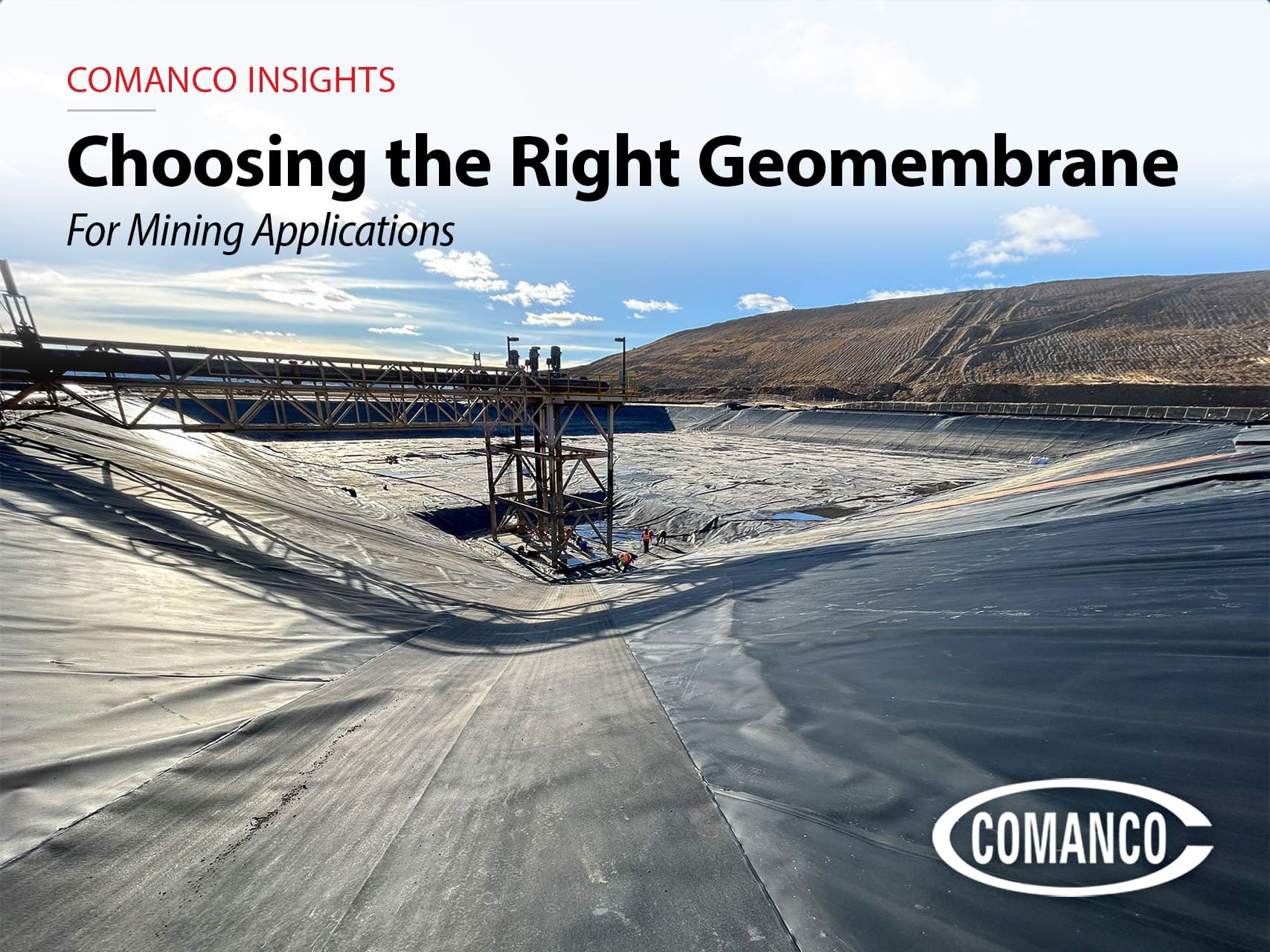
Selecting the right geomembrane starts with understanding the entire containment system.
There is No Universal Geomembrane for Mining Projects
Choosing a geomembrane for a mining project often begins with a simple question: Should the project use HDPE or LLDPE? It seems like a straightforward decision, but the answer is rarely that simple.
Choosing the wrong geomembrane can increase construction costs, complicate installation, reduce operational efficiency, or make future repairs more difficult.
The most successful mining containment systems are not built by selecting the strongest geomembrane. They are built by selecting the right geomembrane for the application.
Every successful selection process begins with the facility itself. A heap leach pad, process pond, tailings storage facility, and secondary containment area each place different demands on a liner system. Every application has its own operating conditions, loading, geometry, chemical exposure, and construction challenges.
A geomembrane that performs well in one mining application may create unnecessary challenges in another.
For example, a liner beneath a heap leach pad must withstand significant loads from ore, drainage materials, and construction equipment. A process pond liner may remain exposed while experiencing fluctuating water levels, thermal movement, and routine maintenance activities. A tailings storage facility may require a liner system capable of accommodating settlement or changing foundation conditions over time.
Those differences influence far more than the choice between HDPE and LLDPE.
They affect the appropriate thickness, surface texture, flexibility, puncture protection, seam design, installation methods, and the performance of the entire containment system. They also influence how the liner should be tested, protected, inspected, and maintained throughout the life of the facility.
For that reason, geomembrane selection should never focus on the material alone.
The geomembrane must work as part of a complete containment system. It works alongside the prepared subgrade, geotextiles, drainage materials, collection piping, structures, and protective layers. Just as importantly, it must remain compatible with the solutions it contains and the environmental conditions it will experience throughout its service life.
Responsibility for the final design and material specification rests with the engineer of record. However, owners, EPC firms, project managers, contractors, and installers all benefit from understanding how those decisions are made. A well-informed project team is better equipped to identify potential risks, ask the right questions, and make decisions that support reliable containment performance.
Ultimately, the right geomembrane is not necessarily the strongest, thickest, or most familiar option. It is the material that best fits the facility, the containment system, and the conditions it will face from construction through operation.
From a construction perspective, successful containment projects depend on more than material selection. Deployment conditions, subgrade preparation, welding quality, access constraints, weather conditions, and long-term maintainability all influence the performance of a geomembrane system. As a containment construction contractor, COMANCO works with owners, EPC firms, and engineers of record to help ensure containment systems are installed in accordance with project specifications and industry best practices.
As a mining containment contractor and geosynthetics contractor, COMANCO understands that the success of a containment system depends on both proper design and proper construction. Factors such as deployment planning, welding quality, subgrade preparation, and long-term maintainability can significantly influence system performance throughout the facility’s life cycle.
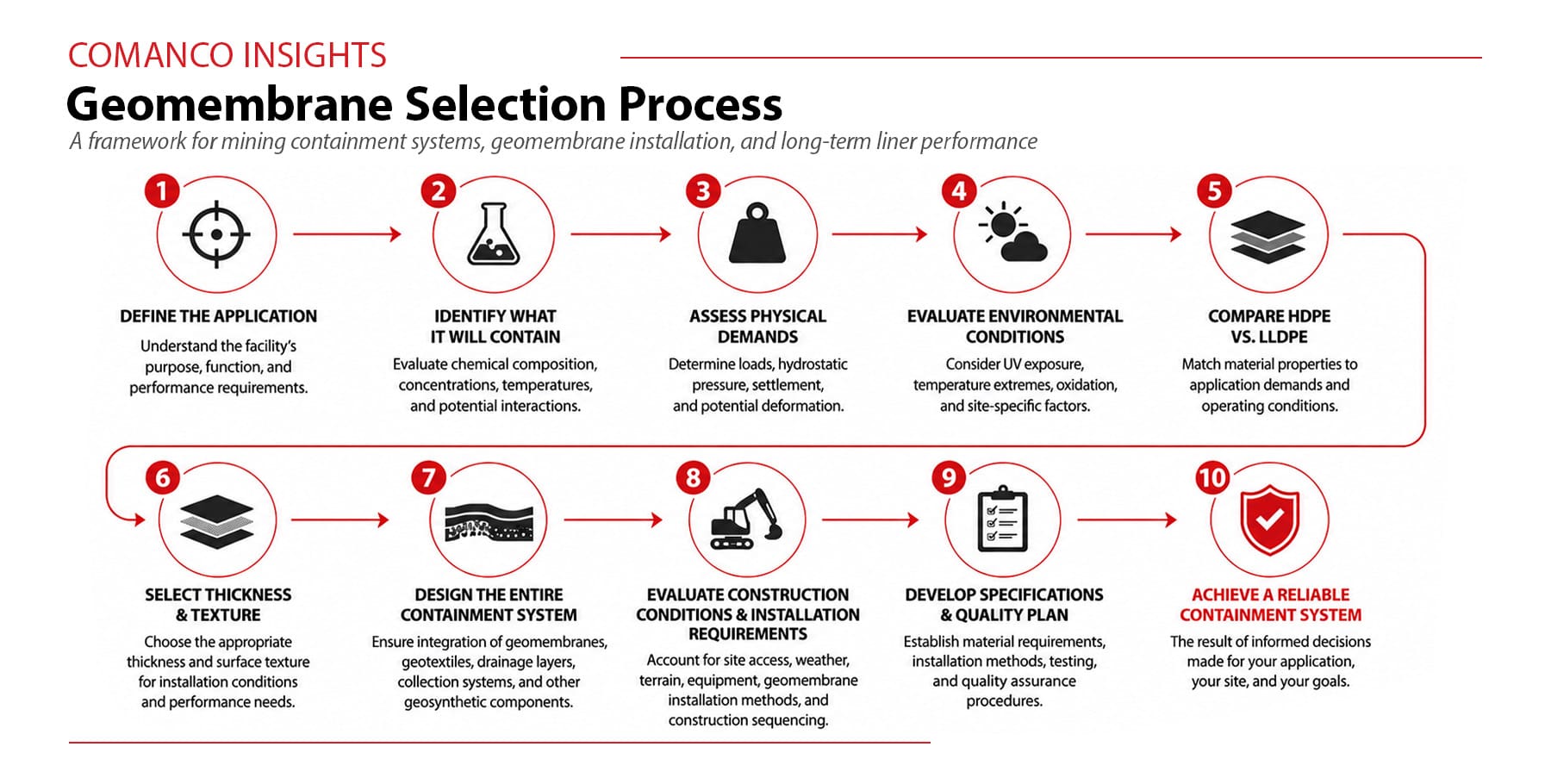
Figure 1. Geomembrane Selection Process for Mining Containment Systems. This selection framework illustrates the key considerations involved in evaluating geomembranes for mining applications, including facility requirements, operating conditions, constructability, geomembrane installation considerations, and long-term containment performance.
Let the Application Guide the Selection
The first step in selecting a geomembrane is understanding what the facility is designed to do.
Mining containment systems serve different purposes. Some hold process solutions. Others support ore, manage tailings, collect contact water, or provide secondary containment. Each application creates a different combination of loads, exposure conditions, and performance requirements.
A heap leach pad, for example, must support large volumes of ore and the equipment used during construction and operation. The liner system may also face concentrated loads from drainage aggregate and collection piping. In this application, subgrade preparation, puncture protection, drainage design, and chemical compatibility all influence geomembrane selection. These considerations are particularly important during heap leach pad construction, where liner performance is closely tied to subgrade preparation, drainage layers, and quality installation practices.
Process solution ponds create a different set of conditions. These liners may remain exposed for long periods while holding pregnant or barren solution. They must perform under hydrostatic pressure, changing liquid levels, ultraviolet exposure, thermal movement, and routine maintenance activities.
Tailings storage facilities present another set of design considerations. The selected geomembrane must accommodate settlement, changing foundation conditions, and staged construction while working with the facility’s geometry, drainage components, and expected deformation throughout its service life.
Other mining applications present their own requirements.
Evaporation ponds may experience fluctuating water levels, concentrated salts, and long periods of direct sunlight. Contact-water and stormwater ponds may operate intermittently but still require reliable containment during major weather events. Secondary containment areas may need to resist chemical exposure while allowing access for inspection, maintenance, or equipment.
Temporary facilities also require careful evaluation. A shorter design life does not remove the need for reliable containment. The project team must still consider the contained material, site conditions, installation methods, and the consequences of a leak.
The facility’s purpose also determines how difficult the liner will be to inspect or repair after construction. A pond liner may remain accessible during scheduled maintenance. A geomembrane beneath millions of tons of ore may not.
That difference can influence the level of protection, testing, quality assurance, and conservatism built into the design.
Every successful geomembrane selection starts with understanding what the facility needs to accomplish. The material selection comes afterward.
Know Your Operating Environment
Once the facility’s purpose has been established, the next step is understanding the environment in which the geomembrane will perform.
Mining operations handle a wide range of process solutions, chemicals, and byproducts. While two facilities may appear similar, the materials they contain can differ significantly in composition, concentration, temperature, and day-to-day operating conditions. Those differences play an important role in selecting the right geomembrane.
One of the first considerations is chemical compatibility.
The geomembrane must maintain its physical properties throughout the life of the facility while remaining compatible with the solutions it contains. Depending on the application, those solutions may include acidic or alkaline process solutions, dissolved metals, high concentrations of salts, hydrocarbons, or other chemical constituents associated with mining and mineral processing.
Operating conditions deserve equal attention. Process chemistry can change over time as ore characteristics, treatment methods, or production demands evolve. The engineer of record should evaluate a geomembrane under both normal operating conditions and reasonably anticipated upset conditions that could expose the liner to different chemical concentrations or temperatures.
Temperature is another important factor that is sometimes overlooked.
Higher temperatures can influence the performance of geomembrane materials and may affect their resistance to certain chemicals. A solution that is compatible at one temperature may behave differently at another. Understanding both the chemical composition and the expected operating temperature helps ensure the selected geomembrane is appropriate for the application.
It is also important to recognize that no geomembrane material is universally compatible with every chemical environment. Performance depends on several factors, including the polymer formulation, chemical concentration, exposure temperature, applied stress, and duration of exposure.
For applications involving aggressive or unusual process solutions, project-specific chemical compatibility evaluations may be appropriate. These assessments help confirm that the selected geomembrane is suitable for the expected operating environment before construction begins. Engineers often rely on manufacturer chemical compatibility data and, when appropriate, project-specific compatibility testing to support material selection.
Chemical compatibility should never be evaluated independently of the rest of the containment system. Seams, penetrations, pipe boots, concrete connections, and repair details are exposed to the same operating environment as the geomembrane itself. Reliable performance depends on every component working together throughout the life of the facility.
Answering these questions helps determine whether a geomembrane is appropriate for the intended operating environment before decisions about material type, thickness, or surface texture are made.
Consider Loads, Settlement, and Subgrade Conditions
Selecting a geomembrane is about more than understanding what the facility will contain. The physical demands placed on the liner system are equally important.
Every mining containment facility places unique physical demands on the geomembrane. Some are predictable, such as the weight of stored liquids or ore. Others develop over time as the facility settles, operating conditions change, or construction activities place additional stress on the liner system.
A heap leach pad illustrates this well. Once ore is stacked, the geomembrane supports loads transferred through the drainage layer and prepared subgrade. If those supporting materials are not properly designed or constructed, localized stress can develop and increase the potential for damage.
The condition of the subgrade is equally important.
Even the highest-quality geomembrane cannot compensate for a poorly prepared foundation. Sharp rocks, protrusions, excessive rutting, abrupt grade changes, or poorly compacted soils can create concentrated stress points beneath the liner. Careful grading, proper compaction, and thorough subgrade preparation create a uniform surface that supports the geomembrane throughout its service life.
Settlement should also be considered early in the design process.
Some mining facilities experience very little movement after construction, while others may undergo gradual settlement as underlying soils consolidate or operating conditions change. Facilities constructed in phases may also experience differential settlement as new sections are added over time. Understanding how the foundation is expected to behave helps determine whether the selected geomembrane can accommodate those conditions throughout the life of the facility.
Physical loading extends beyond normal operations.
Construction equipment, maintenance vehicles, temporary stockpiles, drainage aggregate, concrete structures, and pipe penetrations can all create localized stresses during construction and operation. Identifying these conditions early allows the design team to incorporate appropriate protection measures where they are needed most.
It is also important to recognize that the geomembrane does not perform alone. Protection geotextiles, drainage materials, and the prepared subgrade all work together to distribute loads and reduce the likelihood of puncture or localized damage. In many cases, the performance of the complete liner system is more important than the properties of any individual component.
Understanding the physical demands placed on the containment system helps narrow the range of suitable geomembrane options. The next step is comparing how different materials perform under those conditions and determining which characteristics best support the application’s performance requirements.
Compare HDPE and LLDPE by Performance
By this point, the project team should have a clear understanding of the facility’s purpose, operating environment, expected loads, and site conditions. Those factors provide the context needed to compare geomembrane materials.
For many mining applications, the discussion centers on two commonly specified materials: high-density polyethylene (HDPE) and linear low-density polyethylene (LLDPE). Both have proven performance histories in mining containment systems, but they are designed with different characteristics in mind.
Rather than asking which material is “better,” the more useful question is which material is better suited to the specific demands of the project. In many cases, more than one geomembrane may satisfy a project’s requirements. The goal is to identify the material that best aligns with the facility’s specific design objectives.
HDPE Geomembranes
HDPE geomembranes are widely used throughout the mining industry because they offer an excellent combination of chemical resistance, durability, and reliable performance. Their higher tensile strength and stiffness make them well suited for many permanent containment applications, including heap leach pads, process ponds, and other facilities where environmental protection is a priority.
However, that same stiffness also influences how the material behaves in the field. HDPE is generally less flexible than LLDPE, making it more challenging to conform to irregular subgrades, sharp transitions, and complex details. During installation, crews must also account for thermal expansion and contraction, as temperature changes can affect panel placement and wrinkle development.
LLDPE Geomembranes
LLDPE geomembranes are valued for their flexibility and ability to accommodate movement. Their higher elongation allows the material to conform more easily to irregular surfaces and adapt to some settlement or deformation that may occur during the life of a facility.
These characteristics can make LLDPE an effective choice for applications where flexibility is a primary design consideration. However, like any geomembrane, its suitability depends on the project’s specific operating environment, loading conditions, chemical exposure, and performance requirements. Increased flexibility should not be viewed as a substitute for proper design, subgrade preparation, or protection.
Selecting the Right Material
The differences between HDPE and LLDPE are best viewed as different performance characteristics rather than advantages or disadvantages. One material is not universally better than the other. Each offers properties that may be beneficial depending on the application’s design objectives.
The table below compares several of the performance characteristics commonly considered during material selection.
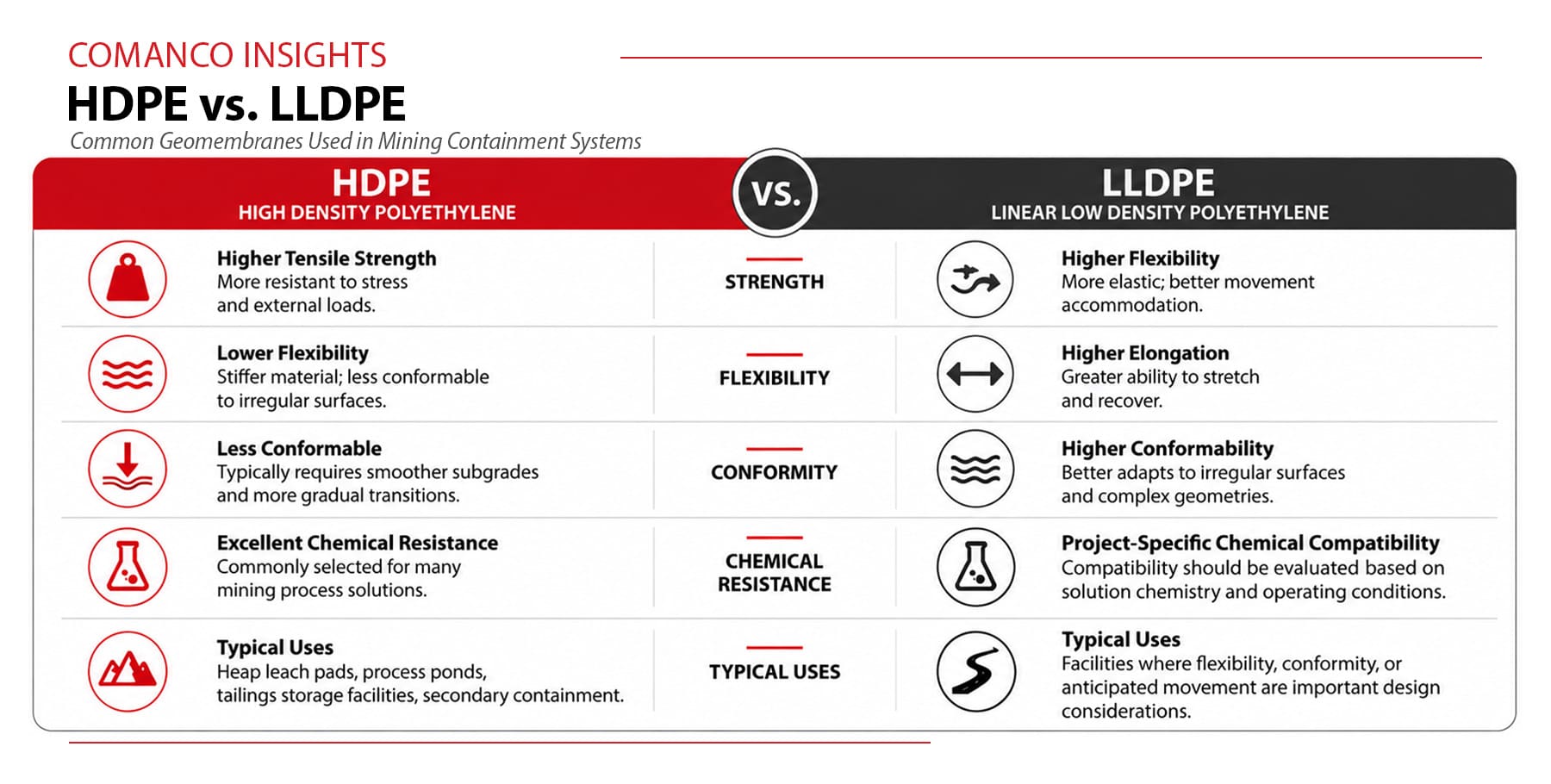
Figure 2. HDPE vs. LLDPE Geomembranes for Mining Containment Applications. Comparison of key performance characteristics commonly considered when evaluating HDPE and LLDPE geomembranes for mining containment systems, geomembrane installation projects, heap leach pads, process ponds, and tailings facilities.
Disclaimer: Performance characteristics shown are general comparisons only. Final geomembrane selection should be based on project-specific design requirements, operating conditions, chemical compatibility evaluations, and the engineer of record’s specifications.
Material selection rarely depends on a single property. Design teams and engineers of record typically evaluate flexibility, strength, chemical compatibility, anticipated movement, constructability, and performance together before determining which geomembrane best supports the application. The final geomembrane selection should always be verified against the engineer of record’s design requirements, project specifications, and applicable regulatory requirements.
Understanding those performance characteristics is only part of the specification process. The next step is determining the appropriate geomembrane thickness and whether a smooth or textured surface is needed for the application.
Select the Right Thickness and Surface Texture
Choosing the appropriate geomembrane material is only part of the selection process. The engineer of record typically determines the thickness and surface characteristics that best support the facility’s design requirements.
Choosing the Right Thickness
Geomembranes are manufactured in a range of thicknesses, and the appropriate selection depends on the specific demands of the project. While thicker geomembranes generally provide greater durability and increased resistance to construction damage, thickness alone does not determine performance because puncture resistance, support conditions, and the liner system also influence field performance.
The expected loading conditions, subgrade quality, overlying materials, and construction methods all influence the required thickness. A well-prepared subgrade with proper protection layers may reduce the risk of puncture, while rough or irregular foundations may require additional protection regardless of geomembrane thickness.
Thickness also affects constructability. Heavier geomembranes provide greater robustness but may require additional handling considerations during deployment, particularly on steep slopes or in areas with complex geometry. The selected thickness should balance durability with practical installation requirements.
Rather than relying on a standard thickness for every project, engineers evaluate the facility’s operating conditions, anticipated loads, regulatory requirements, and owner specifications before making a final recommendation.
Smooth vs. Textured Geomembranes
Surface texture is another important design consideration.
Smooth geomembranes are commonly used in applications where interface friction is not a controlling factor, such as flat areas or facilities with relatively gentle slopes. Textured geomembranes, on the other hand, are designed to increase friction between adjacent materials, making them valuable where slope stability is an important part of the design.
Depending on the application, texturing may be manufactured on one side or both sides of the geomembrane. The appropriate configuration depends on the surrounding materials and which interfaces require additional shear resistance.
It is important to recognize that textured geomembranes are not automatically the best choice for every project. Surface texture can influence material handling, welding procedures, cleaning, and quality control during installation. Like any design decision, it should be selected because it supports the project’s specific performance requirements rather than becoming the default option.
Engineers of record often evaluate interface shear strength, slope geometry, overlying materials, and anticipated loading before determining whether a smooth, single-sided textured, or double-sided textured geomembrane is appropriate.
Thickness and surface texture should always be considered together with the geomembrane material, the operating environment, and the overall containment system. Selecting the right combination helps ensure the liner performs as intended throughout construction, operation, and the facility’s service life.
Examine the Entire Liner System
A geomembrane does not perform independently. Its performance depends on how well it works with every material surrounding it.
Beneath the geomembrane, the prepared subgrade provides the foundation for the entire system. Above it, protection geotextiles, drainage layers, geocomposites, collection piping, protective soils, and, in many applications, millions of tons of ore or stored liquid all influence liner performance.
Each component serves a specific purpose, but they must also function together.
For example, a protective geotextile helps reduce the risk of puncture from angular aggregate or other concentrated loads. Proper geotextile installation helps ensure these protective layers perform as intended throughout construction and operation. Drainage layers help move liquids efficiently while reducing hydraulic pressure on the containment system. When included in the design, geosynthetic clay liners provide an additional barrier beneath the geomembrane. Proper GCL installation helps ensure these materials perform as intended within the overall containment system. Proper drainage geocomposite installation can play an important role in maintaining system performance and supporting long-term containment objectives. Removing or changing any one of these components can affect the performance of the entire system.
Successful liner systems rely on proper geosynthetic installation, including geomembranes, geotextiles, geocomposites, and other components working together as a unified containment solution. Construction quality can significantly affect long-term performance.
The interaction between adjacent materials is equally important.
Where different materials meet, they create interfaces. These interfaces influence how loads are transferred through the liner system and how materials behave on slopes. Engineers of record often evaluate interface shear strength to verify that the selected combination of materials provides adequate stability under anticipated loading conditions.
Selecting a textured geomembrane is only part of the solution. The surrounding materials must also be compatible with that texture. A drainage geocomposite, geotextile, or protective soil layer may interact differently with a textured surface than another material would. Understanding those interactions helps the design team create a containment system that performs as intended.
Constructability should also be considered during system design.
Transitions between slopes and floors, pipe penetrations, concrete structures, sump details, and anchor trenches all introduce complexity to the installation. Thoughtful detailing helps minimize unnecessary seams, simplify construction, and improve long-term performance without compromising the engineer’s design intent.
Successful liner systems are not built by selecting high-quality products independently. They are built by ensuring every component works together as an integrated system. A properly designed geomembrane, combined with compatible supporting materials and thoughtful detailing, provides a stronger and more reliable containment solution than any single product could achieve on its own.
Understanding how these components interact also reinforces an important principle: material selection alone does not determine performance. Installation quality plays an equally important role, beginning with how the system is constructed under actual field conditions.
Account for Climate and Construction Conditions
A geomembrane may satisfy every design requirement on paper, but its performance also depends on how successfully it can be installed under actual field conditions.
Mining projects are often built in remote environments where weather, terrain, and construction logistics constantly influence installation activities.
Temperature is one of the most significant factors.
Geomembranes expand and contract as temperatures change throughout the day. During warmer conditions, panels may expand and develop wrinkles. As temperatures decrease, those wrinkles can relax as the material contracts. Understanding these natural movements helps installation crews sequence work, position panels, and complete welding activities under appropriate conditions.
Cold weather presents its own challenges. Lower temperatures can affect material handling and welding procedures, requiring crews to carefully monitor equipment settings and follow project specifications to produce consistent, high-quality seams.
Wind is another important consideration, particularly at open mining sites.
In the field, wind conditions can significantly affect deployment productivity and installation sequencing. Experienced liner installation crews often adjust panel deployment schedules around changing weather conditions to maintain safety and welding quality. These practical construction considerations are difficult to appreciate from drawings alone but can have a substantial impact on project execution.
Site geometry deserves equal attention.
Long slopes, irregular layouts, pipe penetrations, concrete structures, and transitions between different grades all increase installation complexity. A geomembrane that performs well in laboratory testing should also be practical to deploy, weld, test, and inspect under expected field conditions. Experienced geomembrane installation contractors understand that successful installation requires balancing material performance with real-world site conditions, weather constraints, access limitations, and project schedules.
Constructability should never be viewed as separate from engineering. A containment system that is easier to install correctly often reduces the likelihood of unnecessary seams, difficult repairs, and construction delays. Early coordination between the owner, engineer, and installer can help identify opportunities to simplify details while maintaining the design’s performance objectives.
Successful geomembrane installations require more than selecting the right material. They require a design that can be constructed safely, efficiently, and consistently under the environmental and site conditions the project will encounter.
Specify Performance, Not Just the Geomembrane
Selecting the appropriate geomembrane is only part of the design process. The project specification translates those design decisions into clear requirements that manufacturers, installers, and quality assurance personnel can consistently follow throughout construction.
A well-written specification should clearly define how the containment system is expected to perform rather than simply identifying a product or material.
For example, specifying a “60-mil HDPE geomembrane” provides only limited information. It does not address the project’s operating environment, expected loading conditions, surface texture, quality requirements, testing procedures, or installation expectations. A performance-based specification establishes those requirements so every member of the project team understands the design intent.
An effective geomembrane specification typically addresses several key elements, including:
- Geomembrane material and thickness
- Smooth or textured surfaces
- Required physical and performance properties
- Manufacturer quality control requirements
- Material identification and traceability
- Storage and handling procedures
- Field welding procedures
- Trial seam requirements
- Nondestructive seam testing
- Destructive seam sampling and testing
- Repair procedures
- Construction quality control requirements
- Construction quality assurance requirements
- Documentation and as-built records
Each requirement contributes to a successful installation. Material testing helps verify that manufactured rolls meet project specifications before installation begins. Field quality control confirms that welding procedures and seam construction satisfy project requirements during installation. Construction quality assurance provides independent verification that the completed liner system complies with the project specifications.
Just as importantly, the specification should define performance expectations without unnecessarily restricting the project team. Performance-based specifications allow engineers to establish the required outcomes while giving manufacturers and installers the flexibility to meet those requirements using proven materials, equipment, and construction methods.
A clear specification also helps reduce misunderstandings during construction. When material requirements, testing procedures, acceptance criteria, and documentation expectations are defined before work begins, the project team can focus on execution rather than resolving avoidable questions in the field.
Ultimately, a specification serves as the roadmap for construction. It connects engineering design, material manufacturing, installation, and quality verification into a single document that helps ensure the completed containment system performs as intended throughout its service life.
Involve the Installer Early
The success of a geomembrane installation depends on more than selecting the right material and writing a thorough specification. It also depends on how effectively the containment system can be constructed in the field.
Engaging an experienced geomembrane installer during the design phase provides valuable constructability insight before construction begins. While the engineer of record remains responsible for the final design, early collaboration often helps identify practical opportunities to improve installation efficiency, simplify complex details, reduce unnecessary risk, minimize change orders, and avoid costly field modifications.
One of the most valuable contributions an experienced installer can provide is a constructability review.
During this process, the installer evaluates how the proposed design will be deployed, welded, tested, and completed under actual site conditions. An experienced geomembrane installation contractor can often identify opportunities to simplify panel layouts, reduce unnecessary seams, improve construction sequencing, and enhance overall constructability.
Installers can also provide input on details that are difficult to visualize on design drawings alone. Long slopes, pipe penetrations, anchor trenches, concrete attachments, sump structures, and phased construction all introduce unique installation challenges that benefit from practical field experience.
Early coordination also improves project planning.
Material procurement, panel fabrication, equipment mobilization, access routes, weather considerations, and quality control activities all require planning before construction begins. Discussing these items early helps reduce delays and allows the project team to coordinate installation with other trades working on the site.
Perhaps most importantly, early collaboration helps establish realistic expectations. Constructability discussions encourage owners, engineers, manufacturers, quality assurance personnel, and installers to work together before construction starts, when design adjustments are generally easier and less expensive to implement.
Involving the installer early does not replace engineering design. Instead, it strengthens the design by confirming that the containment system can be constructed safely, efficiently, and in accordance with the project specifications.
Successful mining containment projects are built through collaboration. When design professionals and experienced installers work together from the beginning, the result is often a smoother construction process and a more reliable containment system.
Constructability Can Influence Long-Term Performance
One lesson learned across many containment construction projects is that installation complexity often influences long-term performance. Designs that reduce unnecessary seams, simplify transitions, improve access for testing, and account for real-world construction conditions are often easier to install correctly and maintain throughout the facility’s life. Early collaboration between designers and experienced installers can help identify opportunities to improve constructability without changing the engineer’s design intent.
Consider the Entire Life Cycle
Selecting a geomembrane is an investment in the performance of a containment system. While initial material cost is an important consideration, it should not be the only factor influencing the decision.
Mining containment facilities are expected to perform for years, and in many cases, decades. During that time, the geomembrane may be exposed to changing operating conditions, evolving production requirements, environmental factors, and routine maintenance activities. Evaluating how the liner system will perform throughout its expected service life helps support more informed design decisions.
Accessibility is one factor that is often overlooked.
Some geomembranes remain accessible for routine inspection and maintenance throughout the life of the facility. Others disappear beneath millions of tons of ore, where repairs become far more complex and expensive. The level of accessibility should influence both the design of the containment system and the level of conservatism incorporated into material selection.
The consequences of a liner failure should also be considered. Accessibility for inspection, maintenance, and future liner repair services may influence both the design approach and the construction methods selected for a project.
A leak may interrupt operations, require costly repairs, delay production, or increase environmental risk. While every project strives to prevent these outcomes, understanding their potential impact helps project teams evaluate the overall value of different design options rather than focusing solely on initial procurement costs.
Reliable performance also depends on maintaining the integrity of the entire containment system. A properly selected geomembrane cannot compensate for poor subgrade preparation, inadequate drainage, insufficient quality control, or installation deficiencies. Likewise, a well-constructed liner system benefits from regular inspection and maintenance throughout its service life.
When evaluating geomembrane options, project teams should consider the total cost of ownership rather than the purchase price alone. Material selection, constructability, installation quality, inspection requirements, maintenance, and the potential cost of future repairs all contribute to the overall value of the containment system.
The most successful mining containment projects balance performance, constructability, and reliability. By considering the entire life cycle of the facility, owners, project teams, and engineers can make decisions that support both operational efficiency and environmental protection for years to come.
Why Installation Quality Matters
Selecting the appropriate geomembrane is only part of the equation. Even the best material can underperform if installation quality is compromised.
Successful mining containment facilities depend on proper subgrade preparation, panel deployment, field welding, seam testing, quality control, and protection of the liner throughout construction. Small installation issues can become much more difficult and costly to address once a facility is operational.
From heap leach pads and process ponds to tailings storage facilities and water management infrastructure, installation quality helps determine how well the entire containment system performs over time.
COMANCO specializes in the construction and installation of:
- Geomembrane liner installation
- Geosynthetic installation
- Geosynthetic clay liner (GCL) installation
- Geotextile installation
- Drainage geocomposite installation
- Leak detection and liner repair services
- Process pond construction
- Heap leach pad liner systems
- Tailings containment facilities
- Stormwater and contact-water ponds
- Industrial and environmental containment construction
By working closely with engineers of record, owners, and EPC firms, COMANCO helps ensure containment systems are constructed safely, efficiently, and in accordance with project specifications.
Every Decision Matters
Choosing the right geomembrane is rarely about making one perfect decision. It is the result of a series of informed decisions that work together to support the performance of the entire containment system.
While every mining project presents unique challenges, the selection process generally follows the same progression.
1. Define the application.
Understand the facility’s purpose, operating objectives, and containment requirements.
2. Know the operating environment.
Identify the process solutions, anticipated temperatures, chemical exposure, and any conditions that may influence geomembrane performance.
3. Assess the physical demands.
Consider anticipated loads, settlement, subgrade conditions, and the interaction between the geomembrane and surrounding materials.
4. Compare material characteristics.
Evaluate whether HDPE, LLDPE, or another geomembrane material best supports the project’s performance objectives.
5. Select the appropriate thickness and surface texture.
Choose the combination that provides the right balance of durability, constructability, and interface performance.
6. Examine the entire liner system.
Confirm that the geomembrane, protection layers, drainage materials, and supporting components are designed to work together.
7. Account for construction conditions.
Consider climate, site access, installation sequencing, and field constructability before finalizing the design.
8. Specify performance, not just the geomembrane.
Develop project specifications that clearly communicate material, testing, quality assurance, and installation expectations.
9. Consider the facility’s life cycle.
Evaluate accessibility, inspection, maintenance, repairability, and the overall value of the containment system throughout its expected service life.
10. Involve the installer early.
Encourage collaboration between the owner, engineer, manufacturer, installer, and quality assurance team before construction begins to improve constructability and reduce project risk.
Following a structured process helps project teams move beyond simply selecting a geomembrane. It encourages thoughtful engineering decisions that improve constructability, support environmental protection, and contribute to the reliable performance of the entire containment system.
Successful mining containment systems are built through a series of informed decisions that work together to support safe, reliable, and environmentally responsible performance.
SAFETY ★ QUALITY ★ SERVICE
COMANCO is an environmental, commercial, and civil construction company specializing in constructing containment facilities.
Choosing the right geomembrane requires balancing engineering, constructability, and long-term performance. By evaluating the entire containment system rather than a single material, mining teams can make informed decisions that support reliable operations and environmental protection.
As a leading mining containment contractor, geosynthetics contractor, and containment construction contractor, COMANCO specializes in geomembrane liner installation, heap leach pad construction, process pond construction, tailings facility construction, mining water management systems, and other forms of industrial containment construction. We work closely with mine owners, engineers of record, EPC firms, and general contractors to safely construct high-quality geosynthetic containment systems that meet project specifications and support long-term performance.
Contact COMANCO to learn more.
📍 4301 Sterling Commerce Dr, Plant City, FL 33566
📞 (813) 988-8829
🌐www.comanco.com